

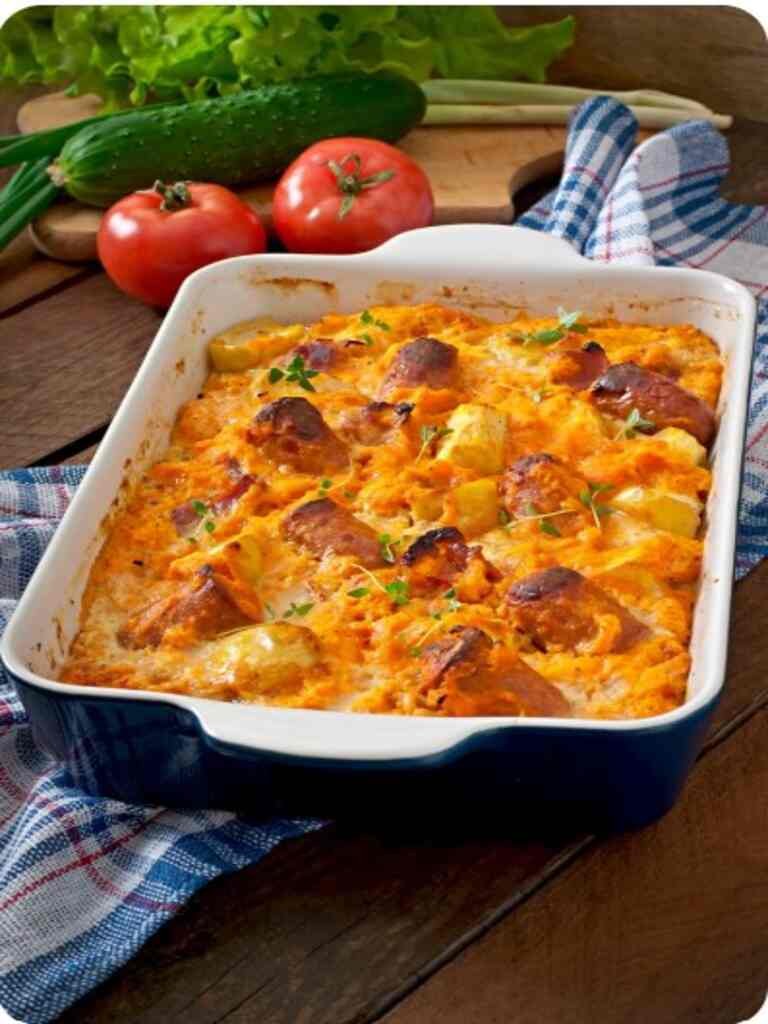
Few dishes represent cultural blending as clearly as Pom. In Suriname, this rich baked casserole is more than comfort food, it’s a celebration dish woven into family gatherings, holidays, and generations of migration stories.
Pom is a baked casserole traditionally made with:
- Chicken
- Citrus juice
- Onions and spices
- Pomtajer root (a starchy tropical root similar to taro)
The grated pomtajer forms the base of the dish, creating a texture somewhere between a casserole and a baked pudding. The chicken is seasoned and layered into the mixture before everything is baked until golden.
The flavor is distinctive: savory yet slightly sweet, rich but brightened by citrus and hearty while still soft and comforting.
Pom is commonly served with rice or bread during celebrations.
Must Read: Bobotie: The Story Behind South Africa’s Sweet Meets Savory
Surinamese Pom and Its Cultural Roots
Description
Few dishes represent cultural blending as clearly as Pom. In Suriname, this rich baked casserole is more than comfort food.
Background and Origin
Pom’s origins are deeply tied to the history of the Jewish communities who migrated to Suriname during the colonial era.
Sephardic Jewish settlers brought European casserole traditions to South America, particularly dishes that used potatoes. But potatoes did not grow easily in Suriname’s tropical climate. Local cooks adapted by replacing them with pomtajer or pomtaya, a root crop better suited to the region.
That substitution changed everything.
Over time, African, Creole, Indigenous, and other cultural influences shaped the recipe further, transforming it into something uniquely Surinamese rather than purely European.
Pom became especially associated with:
- family celebrations
- Christmas gatherings
- weddings and large communal meals
It evolved from adaptation into national identity.
Today, pom survives because it carries memory in layers.
Every tray reflects migration, adjustment, and cultural exchange. It tells the story of people arriving with one tradition and reshaping it using the ingredients and realities around them.
In Suriname, Pom is not simply baked food. It’s proof that cuisine can preserve history while still evolving. And perhaps that is what makes it unforgettable: beneath its golden surface sits a dish built from centuries of adaptation, yet still unmistakably rooted in home.
Ingredients
To Marinate the Chicken
For the Sauce
Casserole
Instructions
How to Prepare Suriname’s Pom Casserole
- Marinate the chicken with the crushed garlic, 1 tablespoon of black pepper, nutmeg, and salt to taste. Deep-fry it and set it aside.
- Put the butter to heat.
- Sauté the onion and garlic for 2 minutes.
- Add the chopped fresh tomatoes and stir-fry for 3 minutes. Add salt to taste and pepper to taste.
- Add a tablespoon of tomato paste and stir-fry for a minute.
- Sprinkle the Maggi powder and one teaspoon of brown sugar.
- Then pour in two cups of water and stir.
- Add the chicken and ketchup. Sprinkle in the chopped celery.
- Cover the pot and let it boil for 5 minutes.
- In a mixing bowl, mix the pom taya and the garlic. Add the pieces of pickles as desired. Remember, this is optional. Add the Maggi powder and celery. Add the salt and pepper. Sprinkle in the ketchup and brown sugar. Add the orange juice. Mix evenly. Add two ladles of chicken sauce, the pom taya, and mix.
- Add the piccalilli and mix.
- Brush the baking dish with butter. Layer in about 2/3 of the pom taya mixture. Then scoop out the chicken from its sauce and layer them on the pom taya mix. Layer on the chicken about 3 ladles of the chicken sauce. Then layer the rest of the pom taya mix. Add some more chicken sauce. About 3 ladles. Add the pieces of butter on top.
- Bake for an hour at over 180 degrees Celsius.
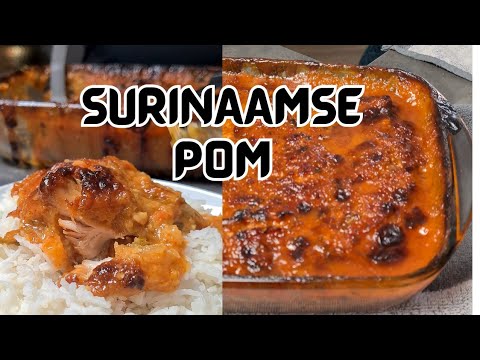
- Serve with boiled rice and enjoy!
 Video source: Cooking with Feffie—YouTube.image-source-magnific
Nutrition Facts
Servings 10
- Amount Per Serving
- Calories 450kcal
- % Daily Value *
- Total Fat 20g31%
- Potassium 500mg15%
- Total Carbohydrate 40g14%
- Protein 25g50%
- Vitamin C 20 mg
- Iron 2 mg
- Magnesium 50 mg
- Zinc 3 mg
* Percent Daily Values are based on a 2,000 calorie diet. Your daily value may be higher or lower depending on your calorie needs.
Note
Tips for Making Suriname
- You can use beef in place of chicken as desired.
- Season the chicken deeply. The chicken carries much of the savory flavor, so marinate it well before baking.
- Balance citrus carefully. Orange or lemon juice should brighten the dish without making it overly sour.
- Cook the filling before baking. Pre-cooking the chicken and onions helps develop richer flavor throughout the casserole.
- Keep the texture moist. Pom should be soft and rich, not dry or crumbly.
- Bake slowly and evenly. Gentle baking allows the flavors to blend while forming a golden top.
- Let it rest before serving. Resting helps the casserole firm up and improves slicing.
Must Read: Fava Bean Stew: How to Make Sudanese Style Ful Medames
Pom reflects the layered cultural history of Suriname through adaptation and creativity. What began as an adjusted version of European casserole traditions evolved into a dish uniquely tied to Surinamese identity.
Rich, comforting, and deeply communal, pom demonstrates how food can preserve memory while continuously transforming with the people who make it.
