

Rye bread stands at the heart of Finland’s cuisine.
It’s baked from whole-grain rye flour, producing a dense, dark, and slightly sour bread that’s beloved for its chewy texture, nutty flavor, and long shelf life. The process involves fermenting a sourdough starter, which gives the rye bread its characteristic tang and makes it more digestible and nutritious.
Rye bread is served at nearly every meal, from breakfast to supper.
Read More: Banitsa: The Crispy Pastry That Bulgarians Love

Rye Bread 101: From Starter to Loaf, A Simple Guide
Description
Rye bread stands at the heart of Finland’s cuisine.
It’s baked from whole-grain rye flour, producing a dense, dark, and slightly sour bread that’s beloved for its chewy texture, nutty flavor, and long shelf life. The process involves fermenting a sourdough starter, which gives the rye bread its characteristic tang and makes it more digestible and nutritious.
Rye bread is served at nearly every meal, from breakfast to supper.
Read More: Banitsa: The Crispy Pastry That Bulgarians Love
Background and Origin
Finnish rye bread has been a staple for over 1,000 years, dating back to when the climate in Finland made rye more reliable to grow than wheat. Rural families would bake large batches of rye bread only a few times a year.
These loaves were designed to last through the long winters, often hung from ceiling poles to dry and preserve them.
The sourdough fermentation method arose out of necessity and tradition, and many Finnish families still pass down century-old sourdough starters through generations — some are even considered family heirlooms!
In 2017, rye bread was voted the national food of Finland in a nationwide poll.
Ingredients
Instructions
How to Bake Rye Bread
- Crush the Finncrisps into small pieces and add them to a glass jar. Add 6 tablespoons of warm water and 1/3 cup of rye flour. Mix them thoroughly with a spoon or ladle.
- Cover the jar with a cloth and put it in a warm place for 24 hours.
- After 24 hours, add a quarter cup of warm water and 1/3 cup of rye flour. Mix them thoroughly. Cover it and keep it in a warm place till the next day, preferably between 10 to 14 hours. This process of mixing rye flour with warm water and keeping it for days is called the starter process.
- Scoop half a cup of the starter into a mixing bowl.
- In a separate mixing cup, mix the dry yeast with a cup of warm water, the sugar and salt. Ensure the yeast has dissolved. Transfer the yeast mixture into the bowl with the starter. Add 1 and a 1/2 cups of rye flour little by little while mixing thoroughly. Add the quarter cup of wheat flour and mix. Cover the bowl and allow the dough to rest for 3 hours.
- The dough will double in size after the 3-hour rest. Add another half cup of rye flour at this point and mix thoroughly.
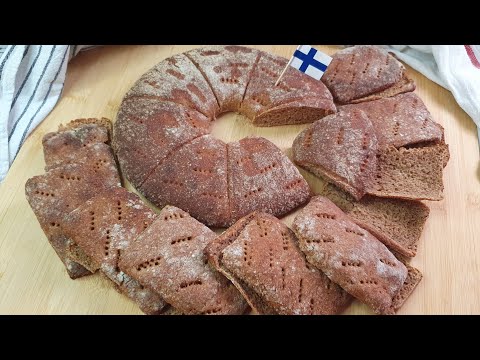
- Sprinkle some rye flour on the table, transfer the dough onto the table and knead. If the dough is sticky, add some rye flour and continue to knead. Use the rolling pin to bring the dough into shape, about half an inch thick. Cut the dough into rectangular shapes about the size of a big biscuit. Tuck the four corners and use a fork to poke small holes on the surfaces.
- Transfer the pieces of dough onto a baking sheet, cover them with a kitchen cloth, and wait for 3 hours. Preheat the oven to 440 Franheiheit. Put some water at the base of the oven to get some steam. Bake the bread for 15 to 18 minutes.
- Once the rye bread is ready, use a knife to crack the edges open. Thus, divide it into two flatbreads while it's still warm, spread some butter in the middle, and enjoy.
 Video Credit: Tuija Tuulia–YouTube
Note
Tips for Making Rye Bread
- Allow the rye bread to cool for a few minutes after baking and cover with a towel. They are fine when still a bit warm. Always spread with butter, of course.
- Remember to freeze the leftover dough for the next baking.
- The original recipe doesn't have yeast or sugar. You can just leave them out if you desire to make rye bread the traditional way. However, proofing may take more time without sugar and yeast.
- You can notice when the rye bread is ready by the drum-like sound when you knock the bottom side.
- If you don’t have ready-made Finncrisps to make a starter, you can also use your favorite Ruispalat and try to break it into very small pieces.
- You can also give 2 more days of fermenting and feeding time for the starter.
Read Also: Apricot Dumplings: A Sweet Taste of Austrian Tradition
Whether topped with butter and cheese, salmon, or just eaten plain, rye bread in Finland is a daily ritual and a powerful symbol of national pride. It’s rustic, wholesome, and proudly unrefined, much like the Finnish spirit itself.
